Showing posts with label witchcraft. Show all posts

Saturday, February 26, 2011

Book Reviews - Vampires and Witches, of Course

Thanks to my graduate school honed skill of speed reading, I got through two books this week. I'm happy to report my findings.


1st up, Abraham Lincoln Vampire Hunter by Seth Grahame-Smith.


Gotta say, it wasn't a book that I felt like I needed to get my hands on at first. When it was first published, I liked the idea, but decided to keep it on the reading list for later. It's central characters are men, it's about killing vampires not loving them, and it wasn't written by an historian. And despite those things, it is a very interesting read. It's an epistolary novel, which is one of my favorite literary forms.


Epistolary novels are stories told through a series of letters or other written documents. They gained popularity in the mid 1700s, the most popular then being Samuel Richardson's Pamela and years later Clarissa, about young women who have their virtue continually tested by the world around them. Epistolary novels do some interesting things that other novels don't. They show you the story from one person's perspective, with 'factual' additions like newspaper clippings or historical documents, and without the value judgments of an omniscient narrator. In many ways this conveys a sense of realism.  You get the story in the character's own words. Some think that the popularity of epistolary novels coincides with the rise of democracy. These are stories that tended to focus on ordinary people, generally the trials and tribulations of the working class or servant class, and in doing so encourage a sense of empathy for the experiences of those who are not like you. I like epistolary novels. Dracula is one of the most famous, with letters and diary entries from the different characters creating the story.


Abraham Lincoln Vampire Hunter begins with the story of a young writer who has given up on his dream of writing a novel. He instead runs the counter at a small town hardware store. He is given a gift one day by a strange local customer: what appears to be the collected diaries of Abraham Lincoln, detailing his life as young boy, and moving all the way through to the days before his assassination.

The stranger asks him to write a novel based on the diaries. As he begins to read these journals, he realizes that Abraham Lincoln was obsessed with, and very good at, killing vampires. He devoted his entire life to ridding the country of them, and only stumbled into politics. Lincoln eventually surmises that the institution of slavery is not only reprehensible on the basis of denying human beings rights, but also because it is held in place by vampires, who buy up the slaves who are old or disabled in order to feed. He believes slavery and vampires go hand in hand, so he sets out to get rid of both.


Even though it's about hunting and killing vampires, there are your "good" vampires, though they aren't as fleshed out as they could be. His good vampire sends him a hit list every now and then, and the story moves forward as Lincoln tries to fulfill his assassinations of the vilest vampires. Lincoln is definitely given a fascinating voice, and a clear picture of him emerges as the novel goes on. He deals with a lot of conflicting values and ideas, and is thoughtful about them.  The novel's historical inaccuracies are plenty, but I didn't find this too troubling. I mean, it's a novel about Abraham Lincoln as a vampire hunter. Changing history to suit the story seems like a no brainer. I loved all of the doctored photos that point out "proof" of the vampire hunter aspect of Lincoln's life. I loved the moral anchor that was the Lincoln character. He doesn't always do the right thing, but he does explore his ideas and opinions.

There were some things that disappointed me, though. It's clear that the writer isn't an historian, and that really makes the novel less than what it could have been. You see it in places throughout the novel, but most of all in the way slavery and the abolitionist movement is presented. Slaves are talked about in the abstract mostly, and usually only as victims. The underground railroad, the work of free blacks in the north, and slave rebellions are all attributed to the "good" vampires who want to end the reign of vampires in the south. Only one of these "good" vampires is developed as a character, and even he is more of a way to move the plot forward than a real person. None of the characters are black, and I think a black "good" vampire would have given the story some depth and add a counterbalance to the depiction of black people as only slaves and only victims with no power over their own lives. Lincoln never encounters other vampire hunters, which is strange. And the story spends so much time on his life before politics, that it seems odd that his road to the presidency was so short and so convenient.


All in all, the book does paint an elaborate picture of Lincoln's life, with vampire stuff added in there. His marriage, children, and the Civil War are all explored in interesting ways. I think probably this could have been an epic story, rather than a whimsical little novel. It's worth it just for the cameo by Edgar Allen Poe, who knows about vampires and chats with Lincoln about it from an interesting perspective!


My second review is a book I found via the Barnes & Noble nook recommendations page. They saw that I liked The Phyisick Book of Deliverance Dane and Daughters of the Witching Hill, and handed me A Discovery of Witches by Deborah Harkness. I was hungry for another novel after finishing Abraham Lincoln Vampire Hunter, and I am glad I went back to witches for a time.


The cover of this novel isn't bad, but it isn't good. I would have preferred it to look like a page from an illuminated manuscript, because it features so prominently in the story, but I don't work in book cover design. I should though. I sometimes wonder what the hell those people are thinking. This is a big one at 592 pages, but I was fascinated the whole way through. It's a witch story, but unlike the last two I reviewed, this one takes place in the contemporary world, without a lot of flashbacks to the past. It's about a world where witches, daemons and vampires have worked hard to keep their existence secret from humans. It's also a world where the three creature groups are insular, and never mix across "species." It's also about the weird world of academics. In this case, however, some of the academics are relics themselves.

Diana Bishop is a witch, but has worked hard to create an academic life without witchcraft. A descendant of one of the Salem witches, she knows the fear and hysteria around witchcraft. She wanted to make a name for herself without resorting to magic, and manages to become a well known historian teaching at Yale. At the start of the novel, she is on a sabbatical doing research at Oxford, analyzing alchemical texts and illuminated manuscripts in the Bodleian Library. Her life changes forever when she requests a particular manuscript from the collection that was once thought lost. It's a book that is sealed shut with a spell, and Diana manages to open it. It seems like a confusing alchemy text that has magic running through it. When she sees the magical aspect of the text, she suddenly decides to return it and tries to forget the experience. The creatures in Oxford take notice, and pretty soon they are hovering around her, waiting for her to recall the manuscript, which is rumored to have secrets about the origins of the supernatural species and powerful spells. Another academic at Oxford seems to be most interested in her and her stack of books at the Bodleian, Matthew Clairmont, a vampire.

This is not your usual vampire romance, but it does go to similar places. What makes this novel different is the careful eye to science and history (the author is an historian of science and medicine at USC). It's not simply the history background that makes Harkness's work great. It's also her ability to create a lush, detailed world, with characters that have flaws and quirks. Even tertiary characters seem modeled on real people. Matthew, the vampire, is a great character, but I had a bad feeling about him at the beginning of the novel when he found Diana's smell to be too intoxicating. These vamps also don't have fangs. Which is stupid. I'm sorry but vampires have fangs. It's the way of things. I won't see them without. Anyway, I was worried he'd head into Edward Cullen territory, but things go a different, more mature way.

I guess that's what I liked best about this novel. It's central character, Diana, is a woman who is "different" like Bella and Sookie and so many others, but she isn't naive or prone to do ridiculous thins to prove she's independent. She is a thinker and mature about her actions. Whereas many other vampire romances are about vampires sweeping women up into their vampire bullshit, this story is about the communal bullshit of supernaturals, and Diana takes control of her life in beautiful and surprising (and sometimes wrong) ways.

The novel is long, but I didn't feel like it when I was reading it, and I wanted it to continue after it was over. If you are reading it and having a hard time moving through it, you should at least push forward to Diana's visit home to her family's witchy house. I could have read a whole novel about that house.

If you liked The Historian, there are elements of academic life, research and travel that are interesting, but it isn't a treasure hunt so much. If you liked The Physick Book of Deliverance Dane and Daughters of the Witching Hill, the culture of witchcraft is fun and fantastical, but the balance of power is not with humans here. If you like vampire romances, this book will provide you with a romance, but you'll have to deal with more than a few mysteries and side-journeys that take away from the romance part. Oh, and the sex is minimal. As in the supe couple never consummate their relationship. Which is the only part that I really disagreed with. Well, that and the princess fairy tale that features in a very small but annoying part of the story.

I'm hoping Harkness writes a sequel, but even if this is the last of Diana Bishop's story, it was a worthwhile trip. It's about time someone capitalized on the fact that real vampires (and people who know they exist) would be excellent academics.

I've got only academic books on the horizon, but I'm hoping to go in a different (but still supernatural) direction. I'm thinking less professor characters and more fuck-ups. A decent fuck-up centric vampire story, incidentally, is Christopher Moore's Bite Me!

Sunday, February 13, 2011

Book Review - The Daughters of the Witching Hill


Well, you know it's been a while when you have to actually log in to Blogger to post a new entry! Good things are afoot people. I am getting transferred out of my crappy department to one where I will no longer be the bringer of sadness. Yes, a great move for me, since I have been dealing with intense stress and anger over being the American Dreamkiller. "Hi, I'm Sweet Lady, you have to pay 100 zillions of dollars by this time next week or your house will be sold at an auction and all your neighbors will see postings about it on your lawn and in the paper. Have a nice day!!"  I have had serious TMJ problems, like so bad that whatever is misaligned in my jaw is messing with the nerves in my neck and shoulders, leading to numbness in my left hand. I stopped sketching and painting. It was a bad scene.  It's not like I won't still be part of the dream killing tangentially, so that still bums me out, but I can't put effort into getting another job until I'm done with the dissertation. My constant refrain. Anyway, in two weeks, I'm moving my cube and enjoying the silence. No phone calls.

I thought I'd drop in on all of you and let you in on a review of a book I recently read. I got some Barnes and Noble gift certificates for the holidays and I have been too busy to use them. CRAZY, I know. But I realized I hadn't read a novel in a while, and I thought that maybe it was part of the reason I wasn't feeling much like myself (other than the job). So I set out to read something new. I had good luck with historical novels, and especially those steeped in real historical research, but with supernatural or paranormal elements. The Historian, Devil in the White City, and The Physick Book of Deliverance Dane were recent favorites, so I tried to see who bought books similar to those on Amazon and B&N's website. It led me to Mary Sharratt's Daughters of the Witching Hill. Excellent choice!

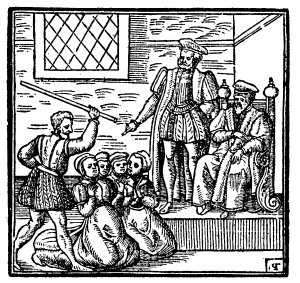
It is based on the real Pendle Hill witch hunts of 1612 in Lancashire, England. Taken primarily from the very detailed and strange testimony of the trials recounted by a contemporary court clerk, it pieces together a magical and tragic (tragical, if you will) story of Elizabeth Southerns, a poor woman who lived in a tower on the outskirts of town and acted as a "cunning woman," someone who practiced folk magic. Sharratt uses social and political history as her background for the story, placing it in this interesting time when Catholicism was under attack by the last two royals. The mysticism and ritual of Catholicism was seen as particularly vile to James I, who had a thing about witches. He wrote Daemonologie, a text defining and denouncing witchcraft. It specifically encouraged witch hunts, and was focused on ousting. Here's an excerpt focusing on the kind of work witches do:

"I mean by such kind of charms as commonly daft wives use, for healing of forspoken [bewitched] goods, for preserving them from evil eyes, by knitting . . . sundry kinds of herbs to the hair or tails of the goods; by curing the worm, by stemming of blood, by healing of horse-crooks, . . . or doing of such like innumerable things by words, without applying anything meet to the part offended, as mediciners do."
The book itself is not so much about the hunts themselves (it gets there, and it's a realistic treatment of it), but more about the belief in magic and its uses, the daily lives of women, and the ways women sought power over their lives when they had virtually none. 

Elisabeth Southerns is poor. So poor that she must beg for food and does hard labor for little pay around town. She has a magical experience one day when she's confronted with a beautiful man, Tibb, who she knows isn't real, but who convinces her that he can predict the future and help her gain some measure of control over her life. He claims that his "Lady" sent him to watch over her. Tibb helps Elizabeth, known as Bess and later as "Old Demdike,"  learn the ways of cunning folk. Using herbs, poultices, and prayers to heal and protect, she manages to turn it into a way to make a living. And some crazy shit happens. 

No seriously, crazy shit happens. Cool magical stuff, regular "people are shitty" stuff.  I found it totally engrossing. I enjoyed being there, in that book, and after Deliverance Dane, it was interesting to see a tale of witchcraft outside of America and connected so clearly to the real political and social history of the time. It was also really cool to see explanations of the spells used, with specific recipes drawn from the literature of the time. 

So, in summation, it has magic (awesome), a female protagonist (necessary), a story of powerful women but not so powerful as to be fantastical (refreshing), and a real tie to history and respect for the people represented (bonus)! I was sad to let them go at the end of the book. You know a book touches you when that's the feeling you get at the end. It's why I love lengthy series. 

Next up, Abraham Lincoln: Vampire Hunter. On account of President's day and stuff. Aren't you excited about that one?


Monday, October 18, 2010

The Physick Book of Deliverance Dane


I love reading anything about the Salem witch trials. While at Barnes & Noble, I came across a book on the discount fiction table and was instantly in love. If you liked The Historian and read paranormal fiction, this would be a great little novel to read.

It's about Connie Goodwin, a graduate student who just passed her doctoral exams in the history department at Harvard. She has a summer before embarking on her dissertation, and rather than doing research like she planned, she ends up having to take charge of repairing and selling her grandmother's long abandoned house near Salem. 

She happens upon a key in an old 17th century family bible in one of the rooms that has a small slip of paper in the hollow that reads: Deliverance Dane. Connie sets out to find out who or what this paper means and in the process learns about her family's connection to the Salem witch trials. What follows is part intellectual quest, part family history, part magical experience.

It was nice to read a stand-alone book. It was nice to read a historical novel by someone well versed in the history. Kathleen Howe is herself a descendant of two of the Salem witches and holds a doctorate in American and New England studies.

And wonder of wonders, not one vampire in the whole novel.

In other news, today was my first day at work. Not much happened, I'm exhausted, but employed, so yay! I don't have new employee orientation until tomorrow, but I'm pretty sure it's exactly like working in every other office in America. And maybe Canada.

In the words of some of my new coworkers, see youse tomorrah!

Monday, September 27, 2010

Harry Potter's Life is Freaking Sad

I decided to have a Harry Potter marathon this weekend, and watched all the films one after another. I had read the books very sporadically, and I saw the movies when they ended up on HBO (except the Half Blood Prince, which I saw in the theater). I am surprised at what the story looks like when you see it all in a row. It's a dark and brooding story, but I never realized how deeply depressing it is.


Spoilers for the Deathly Hallows book may be ahead...


Many of you have probably heard of Harry Potter. I'm not sure how many of you are fans and have seen the films, but even if you haven't, you probably know it's about wizards and witches and a school for wizard kids. Most of the cutesy fantasy stuff gets into the trailers and commercials. Stuff like the candles that float all by themselves, lighting the great hall of this beautiful boarding school:


Or the fun magical charms and curses that the students learn


Or the silly fun that's made of goofy students whose spells don't work right


There are hints of the darkness in the story early on in the form of school bullies like Draco Malfoy


And mean teachers like Severus Snape


But let's get real, folks, this story is about complete and utter tragedy and sadness. Like, from beginning to end!

The Tragedy of Harry Potter

Not only are Harry's parents killed when he is a baby, but they basically die defending him from an evil sorcerer who is still at large. As an orphan he is given to his uncle's family (the Dursley's) to be raised as basically a prisoner. He's not considered part of the family, he is often pad locked into his bedroom, and they treat their own son so preferentially that he is the only one in family photos.


Once he gets the intel about who his parents were and how they died (the Dursley's didn't tell him), he gets to go to wizard school at Hogwarts, where he finds a couple friends (Hermoine and Ron) and at least one enemy in Draco Malfoy. And of course there's the big enemy in Voldemort, the guy that killed his parents.


Over the course of the movies (the movie stories are most recent in my memory), he at first has to grapple with the huge mind-shift that must happen when you find out that a) your parents were killed and didn't die in a car accident like you've been told, b) they were magical wizards which are real and you are too, c) an evil magical wizard killed them and is currently unaccounted for, and d) you are eleven years old. Christ.


Then he has to fight this super-strong murderous wizard for like 7 years. Each year he is basically tortured from afar by this guy. He has awful nightmares, the scar that Voldemort gave him as a baby hurts sometimes, he is put through a series of deadly tests that are all sabotaged in some way.  His story is front-page news and everyone refers to him as "The Boy Who Lived," which sucks in a million ways. To be remembered simply for surviving and to be thought of as either a huge hope for the future (pressure) or the sad remains of a loved wizard family (pressure!). He gets treated like a special kid in the worst way.

The adults who have information about his past, present, and future are really REALLY vague about it and sometimes don't tell him things that he needs to know to stay alive. The only adult men in his life that he builds close ties to (Dumbledore and Sirius Black) die before the series end. He loses like 3 father/father figures in the course of the story!

You can write an epilogue that tells me he marries Ginny Weasley all you want, but I think that guy is effed up forever. He should totally have been Severus Snape by the end of the story, burdened by a fate and a past he had little control over.

I found that by the end of the Order of the Phoenix, I was so deeply sad about his story (knowing, of course how it ends) that it took me a day long break to get back to it. And this story has a supposedly happy ending!

The best thing this series did for me was introduce Hermoine Granger, one of the best female characters ever. I heart her nerdy lovely overcompensating little heart. I can't even say I see myself in her too much because she's so much more A+ than I ever was. But the nerdyness, the love of information, the desire to always have the right answer and being kind of pissy when you don't have it, that's totally me. I love how fierce she is about the downtrodden and how she fights back when cornered. She threw an amazing punch that landed on Draco's jaw in Prisoner of Azkaban that made me think the books shoulda put her at the center. Hermoine Granger rules forever into all time.  And eventually she works for the liberation and fair treatment of house elves.


And seriously, I think that it is simply inconceivable to me that Hermoine would be interested in Ron Weasley. He's totally the worst Weasley. And there are a lot of them! He's a blubbering idiot who, for a person raised in a wizarding family of 9 people, has little understanding of body language or subtext in a conversation. Or even the literal interpretation of a conversation. He is brave on occasion, but damn if he isn't going to be a lifelong project for our lovely Hermoine, who will be fixing things he's broken and reminding him of basic information forever.  I just can't see her being into someone so not smart or good at spells. I never got that. Does she respect Ron? Really? He's loyal and willing to stick up for his friends, but is that all you need in a partner? Is she so insecure about her abilities that she needs someone less smart around to feel better about herself? That would make for a sad story. I would have liked to see Hermoine with Harry, because they seem to both be burdened by the expectations and assumptions of their family line and yet fight hard to make things right for themselves on their own terms. But even more, I would have liked her to find her own guy, separate from the trio. But maybe I'm just super hard on Ron.

I obviously love the story, and am kind of amazed that little kids got into it on such a large scale. I know people had problems with the witchcraft and stuff, but those are crazy people. What I'd be interested to know is if people would be cool with their kids reading such a dark story, if they had known how it was going to turn out and what horrible trials Harry and his friends would endure. I like dark stories and I'd probably let my kids watch whatever they wanted, but when you look at the stories altogether, damn if it isn't some depressing shit.

Side note: While typing this, M. who is a smart and curious guy, but who hates Harry Potter movies, asked me what I was blogging about and this is how our conversation went:

M: What are you blogging about? Are you blogging about me?  (He always asks this and it's never him)
Sweet Lady: Harry Potter
M: Are you blogging about how you're in loooove with Harry Potter?
Sweet Lady: No, I'm actually not attracted to Harry in the series.
M: Who are you attracted to?
Sweet Lady: Guess which one I would be attracted to. (At this point I'm clearly thinking it's obvious, but I'm also realizing he has no clue because he hates all things magical and has never seen the movies)
M: Gargamel?
Sweet Lady: Seriously? Gargamel from The Smurfs?!
M: Well I don't f*%$ing know!
Sweet Lady: Severus Snape (showing him my Google Image search of Severus in his many stern poses)
M: The old guy!?
Sweet Lady: But...
M: All I have to say is: old balls.
Sweet Lady: Sigh

And I talk shit about Hermoine's choices.